
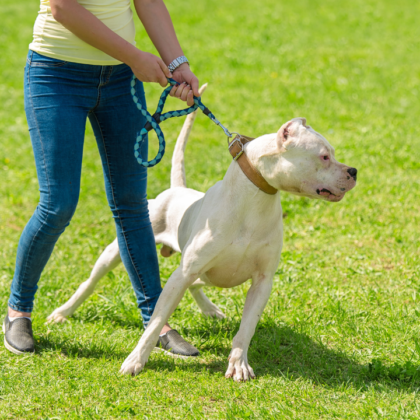
Most of us file pulling under “manners.” It’s annoying, it’s hard on your shoulder, and it looks a little undignified in the vet’s waiting room.
But pulling is also doing something to the dog, past the physical insult of pressure against collar or harness which can be dangerous for the dog’s body. Pulling has mental and emotional effects as well.
The loop
Tension on the leash increases arousal. Straining toward something you can’t quite reach is frustrating (anyone who has ever been stuck in traffic knows the feeling), and frustration is arousing too. A more frustrated, aroused dog pulls harder, which means more tension, which means more arousal. Round and round we go!
Tension travels up the leash too
We usually think of the leash as carrying information from us to the dog. We may forget that tension also carries information back to us. What comes back isn’t kind to our bodies or our minds.
When the leash goes tight, so do we. Our shoulders rise, our grip clamps down, our jaws clench and then breathing gets shallow or stops altogether. Our balance is affected, leaving us feeling alarmed or unsafe. It becomes harder to think clearly and to stay patient, which is exactly what we need most in that moment.
Dogs do not miss any of this. Imagine being a passenger in a car with a driver who suddenly tenses up, white-knuckling the wheel. Before you’ve even seen the problem, the driver’s tensions affects and alarms you. Emotions can be contagious. Dogs are experts at reading the people they live with, and a handler who has tightened the leash, held their breath, and stiffened has just said something loud. “Uh oh…”
What the dog concludes depends on the dog. Say a person and dog are walking down the street, and another dog and person appear. Your dog has just felt you tighten up. Some dogs read that as “whatever just showed up is worrying my handler,” and they respond accordingly: Let’s get out of here. Others decide it’s their job to deal with it: You go away! My handler was calm until you showed up!
Meanwhile, the handler isn’t worried about the other dog at all. They’re worried that their own dog is about to be out of control, and they’re using leash tension to control the dog’s body. The dog doesn’t know that. All the dog knows is that the person on the other end got tense when something appeared.
So the picture looks like this: handler tension raises dog arousal, dog arousal raises handler worry, and the loop closes.
What I’ve noticed
I have never seen a “reactive” dog who did not pull.
I’m not claiming pulling causes reactivity. But the two keep very close company. A dog has usually practiced pulling thousands of times, every one of those steps rehearsing being aroused, frustrated, and disconnected on leash.
Pulling is a symptom of missing skills
Notice I said skills, plural. And the missing skills are often on both ends of the leash.
The dog may not have learned how to walk with someone, how to stay connected when the world gets interesting, or how to handle frustration. That’s the end we usually talk about. There are countless techniques and tools used to address the dog’s pulling.
But the other end – the handler’s skills – gets less attention. A skilled handler does not allow a dog to pull, and knows how to make that happen: how to hold the leash, where to put their hands, how to manage their own speed, how to take tension out from their side. These are learnable skills, and yet rarely are they taught. We were handed a leash and a dog and wished good luck, sometimes with a wry chuckle, “Who’s walking who?” as if pulling were amusing.
Where to start
If tension is the fuel, taking tension out of the leash is a good place to begin. And since it takes two to play the pulling game, one of the players is you.
For now, just notice how often there is tension on your leash, and what your dog looks like when it’s there. Change begins with awareness.
The Art of Leash Handling is now available – learn good leash handling – a foundational skill that affects everything else in training, and in our relationships with dogs. Whether your goal is a quiet walk or top competition, resolving behavior issues or building a solid foundation, leash handling is where your values as a trainer show up in your hands.
In the Art of Leash Handling you will learn how to:
- Stay balanced, responsive, safe & secure. Learn how, why and when to use various leash holds with good mechanics.
- Give the dog what the moment needs. Effective use of the leash from a crowded doorway to an open field.
- Give your hands landmarks they can feel. Magic Knots and color-coding provide useful feedback.
- Know what to do in tough moments. Stop forward motion while staying balanced, regain control, and move the dog out of a hard moment calmly and safely.
This is not a course on loose leash walking, it helps you become a better leash handler. Humane training is built on a promise: to use the leash, collar, harness and other equipment as gently and clearly as possible, without fear, pain or coercion. This course builds the handling skills that let you keep that promise.
