
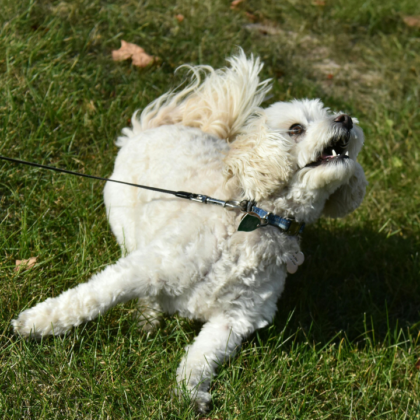
“How do I stop my dog from pulling?” is the question I hear most. If I had an easy answer, I’d probably be writing to you from my own personal tropical island! Trainers around the world have been working on an answer probably for centuries. It’s a good and fair question, but it jumps to the fix before we know what we’re fixing.
A better starting point is this: Why is your dog pulling? There’s rarely a single answer. Here are five common ones, with some questions to ask yourself about each.
- Dog is frustrated
Frustrated by what, exactly?
- Something they want and can’t reach? This could be a person, another dog, another animal, a toy, even a delicious smelling pee-mail tree.
- Being restrained when they’d like to move? Sometimes, a dog is just wanting to move on and get somewhere but we have other plans.
- A walk that’s far too slow, or too stop-and-go? Humans are slow-pokes, by dog standards. On top of that, we often set unwelcome limits for dogs.
Frustration is arousing, and arousal makes pulling worse. If you can find the source of the frustration, you can decide what you are going to do about it.
- There is tension on the leash
Who is initiating the tension in the leash? Who is maintaining it? How? And, importantly, why?
Have you ever seen a dog pulling off leash?
I rest my case.
A tight leash doesn’t happen by itself. Somebody is maintaining that tension. And it can be a mutual event, with both ends of the leash contributing. It can be the handler: hands held rigidly, arm extended, a leash too short to permit any slack, a shortened grip for physical control. Dogs are very good at leaning into pressure – particularly when it is an inescapable condition of being on leash! Tension on the leash invites tension from the dog, and the loop is up and running.
Ask yourself how tension is being created, by whom, and why and when it’s being maintained. As our popular shirt and poster say, “If you’re hanging on to their body, it’s because you lost their mind.” (Want a shirt of your own? Check out our hoodies here and t-shirts here).
- Because it works
Here’s the one nobody likes. Even if the dog has to drag you along one inch at a time, they get closer to where they want to be, or may actually get there. That’s reinforcement. Each step forward on a tight leash pays off, and the dog gets paid thousands of times over a walk.
The dog isn’t being stubborn. They’re showing you what behavior is effective for them. They do not lay awake at night dreaming up better ways to get there without pulling. If it works, they will do it.
- They don’t want to go there
Sometimes the dog is pulling away from something while the handler insists on going toward it. It could be as alarming as a vet’s office, or as simple as an offensive smell on the sidewalk, a worrisome dog, an unwanted interaction with a stranger. The question to be asking is this: Is your dog pulling to something, or pulling away from something?
Why the dog is pulling matters, and is key to figuring out how to help the dog.
- Controlling the dog’s body, not their mind
When a dog is overwhelmed, a tight leash can be used to physically hold them in place or set limits. Of course, that management through the leash doesn’t touch what’s happening in the dog’s head. Even though the body is managed, the dog’s mind is still somewhere else.
There is often a second layer which complicates things. Worried about the dog being out of control, the handler tightens the leash. The dog picks up on the new tension and may decide something worrisome is nearby, arousal goes up, and attention goes to scanning the environment for the new threat.
This is where connection matters. A leash can hold a dog’s body with you. But a leash can’t create attention.
What to do with this list
Which sounds most like your walks (pulls?). There can be more than one. There often is. The fixes are different for each, but all of the solutions start with the same thing: handling skills that take tension out of your end of the leash, and keep you from being the unwitting source of it. Have you worked on your end of the leash or have you been focused on your dog?
Do you want to be a better leash handler? A better partner to your dog?
Suzanne offers The Art of Leash Handling – an online course made up of videos, diagrams, written instructions and webinars designed to help you build the skills on your end of the leash. This is not a course on loose leash walking – this is a course that helps you become the handler your dog needs.
Find out more HERE!
