
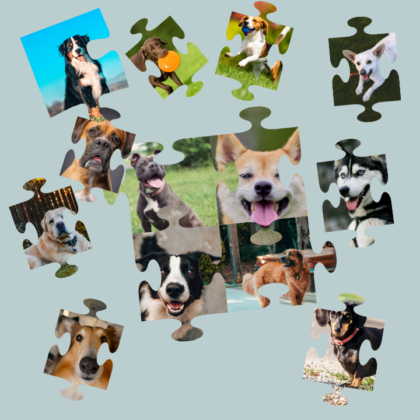
Picture a jigsaw puzzle with five hundred pieces scattered across your dining room table. You’re staring at all those pieces, overwhelmed, wondering where to even begin. Then you spot it—that distinctive corner piece with the bright blue sky. Suddenly, you have a starting point. Everything else will build from here.
That’s exactly what The Auto Check-in (ACI) is in the complex puzzle of helping reactive dogs: the corner piece that makes everything else possible.
What We’re Really Building
For over forty years, I’ve watched handlers struggle with reactive dogs. They’ve learned techniques, collected tools, practiced protocols. But something fundamental was missing—a way for the dog and handler to actually communicate with each other in moments that matter most.
The Auto Check-in isn’t just another behavior to train. It’s a communication system, a partnership protocol, a way for the dog to ask “What do you think about this?” and for their handler to answer in ways their dog understands and trusts.
Think about your most important human relationships. They don’t work because you’re constantly telling the other person what to do. They work because you’ve developed ways to check in with each other, to read each other’s state, to offer support or space as needed. That’s what we’re creating with our dogs through ACI.
From Management to Partnership
Here’s what typically happens with reactive dogs: The handler becomes a full-time manager, constantly vigilant, always one step ahead, preventing, redirecting, controlling. It’s exhausting. And more importantly, it leaves the dog entirely dependent on the handler’s management, never learning to participate in their own regulation.
The Auto Check-in flips this dynamic entirely. When a dog voluntarily makes eye contact with their handler, they’re not being compliant—they’re being collaborative. They’re saying, “I see something interesting/concerning/exciting. What’s your take on this?”
And here’s the beautiful part: Once a dog learns that checking in always results in useful information—support when needed, permission when appropriate, guidance when things are unclear—they start doing it more. Not because you’ve drilled a behavior, but because they’ve discovered that connection actually works.
The Arousal-O-Meter You’ve Been Missing
One of the most powerful aspects of ACI is what it reveals about the dog’s state. Think of it as an arousal-o-meter, and it’s remarkably accurate.
When your dog can easily make eye contact with you even though something interesting is happening, they’re in what I call the Think & Learn Zone (TLZ)—that space where they can think, learn, and make good choices. Their brain is online. They are with you. This is a training moment.
When the check-in gets “sticky”—delayed, effortful, or can’t happen at all—arousal is climbing. Focus is being pulled away. The brain is moving offline. This is not a training moment. This is a management moment.
This distinction changes everything. How many times have you pushed forward with training when your dog couldn’t actually learn? How many times has a situation escalated because you didn’t have a clear read on your dog’s state?
The ACI gives you that read, clearly and reliably. No matter where you are, no matter what’s happening around you. Five seconds becomes your rule of thumb: If your dog can’t check in within five seconds, something needs to change. The environment is too difficult, arousal is too high, or your dog needs more support.
It Starts Simple (And That’s Exactly Right)
The foundation of ACI is beautifully straightforward. You’re not asking your dog to perform a complex behavior. You’re simply waiting for voluntary eye contact and then rewarding it generously.
No calling. No prompting. No kissy noises or hand movements. Just patience and genuine appreciation when your dog chooses to look at you.
Why not try to snag the dog’s attention? Because we’re building something voluntary. Every time you prompt or lure, you undermine the very thing you’re trying to create—your dog’s choice to connect.
And that generous reinforcement? That’s not about bribing your dog. It’s about building value for the behavior. In the beginning, that might mean 10-15 tiny treats delivered one at a time, each coupled with genuine praise. You’re not just rewarding a glance—you’re building a communication system that your dog will rely on in challenging moments.
Why This Matters for Connection
Connection isn’t something that happens once and then remains fixed. It’s dynamic, constantly being created and recreated through thousands of small interactions. The Auto Check-in gives you and your dog a way to maintain that connection even when the world gets challenging.
Without ACI, handlers end up in a constant state of telling—”Leave it,” “Look at me,” “No,” “Eh-eh.” Or they may end up in a purely transactional relationship, trying to use treats and toys to garner and keep the dog’s attention.
With ACI, something shifts. The dog becomes an active participant. They begin checking in when they need guidance, support or permission. The relationship transforms from handler constantly managing dog to two beings working together to navigate a complex world.
That’s not just a training win. That’s a relationship win.
And that’s why The Auto Check-in is the first piece of the puzzle in the Reactivity Repair Kit. Everything else builds on this foundation of voluntary connection and communication.
Want to learn more about building this foundation with reactive dogs?
The Reactivity Repair Kit provides trainers and dog professionals with the complete system for teaching The Auto Check-in and integrating it with the other essential Relationship Centered Training skills Suzanne uses to help reactive dogs.
The course is scheduled to open January 1st, but you can get it for a special pre-sale rate of $425 now through December 31st, 2025 – after the course opens the price will go up to $495.
