
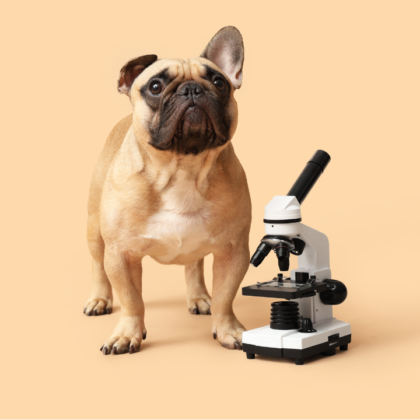
Every interaction with a dog is an experiment. The question is: are you a good scientist?
Most people approach their dogs with certainty rather than curiosity. “He’s being stubborn.” “She’s trying to give me the paw.” “This dog just needs more exercise.” These aren’t scientific observations – they’re conclusions masquerading as facts, assumptions that shut down inquiry before it can begin.
Real science starts with curiosity, proceeds through careful observation, and remains open to having initial hypotheses proven wrong. When you bring this approach to your relationship with dogs, everything changes.
What Real Field Research Looks Like
Karl von Frisch began studying honeybees in 1923 with a simple goal: prove that bees could distinguish colors and shapes of flowers. What started as a highly focused investigation expanded into decades of observation that eventually decoded the complex “waggle dance” communication system that allows bees to share detailed information about food sources with their hive mates. And he did it without video or computers.
Years later, he shared the 1973 Nobel Prize in Physiology/Medicine with Konrad Lorenz and Nikolaas Tinbergen. (It was a very good year for ethologists!)
This is what field research actually requires: a field researcher studying the behavior of animals in their natural environment. Not the controlled laboratory kind with carefully managed variables, but the ethologist working under “field conditions” with all their benefits and challenges. Sound familiar? It’s what dog trainers do every day.
The difference is crucial. Laboratory scientists can control for variables, eliminate confounding factors, work with genetically similar subjects under identical conditions. Dog trainers work with an amazing variety of individuals under constantly changing circumstances – exactly the challenging conditions that provide the richest information about how behavior actually works in the real world.
Your Daily Experiments
Whether you realize it or not, you’re already conducting experiments every time you interact with a dog. Here’s how it usually goes:
You form a hypothesis: “This dog is friendly.”
You look for evidence: “His tail is wagging! And he’s coming right to me!”
You reach a conclusion: “That proves he’s friendly.”
You act on your conclusion: You reach out to pet him.
Sometimes this works fine. Sometimes you learn the hard way that your hypothesis was wrong and your evidence was inadequate. “Hey – he bit me!”
Wonderful work forming a hypothesis – that’s exactly what good scientists do. The problem is that most of us are terrible at gathering evidence.
A more scientific approach might notice: wagging tail (but held high and stiff), approaching (but with tense body language and direct stare), seeking contact (but with pushy, space-invading behavior rather than polite invitation). The same basic behaviors, but observed with more nuance, reveal a very different picture.
The Art of Asking Better Questions
Good scientists don’t just gather more data – they ask better questions. Instead of “Why is my dog being bad?” try “What is my dog trying to tell me?” Instead of “How do I make him stop?” ask “What does he need in order to succeed?”
This shift from judgment to curiosity opens up entirely different possibilities. A dog who pulls on leash isn’t “stubborn” – they might be excited about exploration, or responding to your own tension transmitted through the leash. A dog who won’t come when called might find the environment too stimulating, or may have learned that coming when called ends all the fun.
This observation based thinking offers a fundamentally different way of engaging with the world, which results in a different approach to training. Instead of rushing to judgment about a dog’s behavior, you learn to sustain curiosity. Instead of generic solutions, you develop individualized approaches based on careful observation of what’s actually happening.
The dogs are complex individuals with rich inner lives, unique personalities, and important information to share. When you approach them with the curiosity and careful observation, you honor that complexity and open the door to genuine understanding. You learn to really SEE THE DOG.
The most important research of your life is waiting right at the other end of the leash.
You will learn to:
Develop pattern recognition – like Karl von Frisch spending decades observing honey bees until he decoded their “waggle dance” communication system.
Create effective field notes – capturing complex, fast-moving behavior in ways that remain meaningful months later.
Practice scientific inquiry – approaching each interaction with curiosity, working hypotheses, and real-world research skills.
Early Bird Dog Pricing available through March 29th – Save $50!
Payment plans and scholarships also available!
