
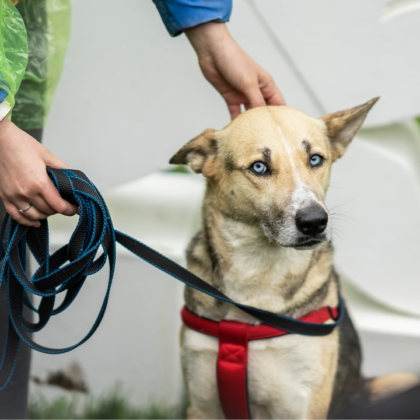
They are the dogs who flatten themselves against the wall when a stranger walks in. The ones who will accept a treat from your hand only if you look away and hold very still. The shelter dog who is perfectly fine with the staff who feed them every day but becomes a different animal entirely when a new volunteer reaches for the leash. The rescue dog who has been in your home for three months and still leaves the room when company arrives. The dog who wants desperately to greet people and then, when the moment comes, cannot quite manage it without either shutting down or exploding.
You have probably met this dog. You may live with this dog. You might work with dozens of them every week.
These are shy dogs, fearful dogs, socially awkward dogs. Dogs whose history, temperament, early experiences, or some combination of all three have left them genuinely uncertain about people, or about certain kinds of people, or about certain kinds of situations involving people. They are not bad dogs. They are not damaged beyond reach. They are dogs who have not yet found a way through.
What Usually Gets Tried
Most people who care about these dogs try hard to help them. They give the dog time and space. They ask visitors to ignore the dog, let the dog come to them, toss treats without making eye contact. They manage situations carefully. They read what they can find. Sometimes things improve slowly, sometimes not much at all.
The frustration is real. So is the helplessness that comes from caring about a dog who is struggling and not having a clear path forward.
What Treat/Retreat First Aid Offers
Treat/Retreat is a protocol developed by Suzanne Clothier for helping shy, fearful, and socially awkward dogs learn to navigate interactions with people. Treat/Retreat First Aid is the foundational version of that work, designed for people who are not professional trainers but who find themselves in the middle of exactly these situations and want something principled and practical to draw on.
The approach is built on a few ideas that, once you understand them, change how you see every interaction with a worried dog.
The dog determines the safe distance. Not you, not the handler, not whoever is trying to be friendly. The dog decides where their comfortable boundary is, and the work begins from that honest starting point rather than from wherever you wish it could begin.
The dog approaches voluntarily. Nothing in Treat/Retreat involves moving toward the dog, encouraging the dog forward, or using food to pull the dog closer than they have decided to come. The dog chooses to approach, and is then sent back to safety before anything has a chance to go wrong. That cycle of safe approach and safe retreat, repeated at the dog’s own pace, is what actually builds confidence.
The dog’s body language and behavior drive the session. Reading what a dog is communicating through their posture, movement, and behavior is central to the work. A dog who is stretching or leaning to reach a treat is telling you they do not feel safe coming closer. A dog who is eating easily and moving fluidly is telling you something quite different. Learning to read those signals accurately is part of what the course teaches.
First Aid, Not the Full Story
The first aid analogy is worth taking seriously. First aid is not medical school. It does not replace professional help when professional help is what is needed. What it does is give you real skills that can genuinely help in the situations you are actually in, right now, with the dogs in front of you.
Some dogs will make remarkable progress with Treat/Retreat First Aid skills applied consistently and thoughtfully. Others will benefit, and then reach a point where more depth is needed. The course is designed to be honest about both of those possibilities, and to point clearly toward next steps when the time comes.
But for a shy dog who flattens at the sight of strangers, for a fearful dog at a shelter who needs to be handleable by new people, for a socially awkward dog who wants connection and doesn’t know how to get there without making a mess of it: Treat/Retreat First Aid is an excellent place to start a conversation built on respect, observation, safety, and the dog’s own choices.
If the scenarios at the beginning of this piece sounded familiar, you are probably already working harder than you need to. There is a better way to help, and it begins with the dog.
Treat/Retreat First Aid is a new online course for dog owners, shelter and rescue workers, and anyone who works with shy or fearful dogs. Learn more about Treat/Retreat First Aid here. It is available now at a special introductory price!
Looking for more? Are you a professional ready to make meaningful change in the life of dogs and their owners? Then you might be ready for our Treat/Retreat Certification course – you can find out more here.
Treat/Retreat Certification is for trainers who:
- Want to take the guess work out of helping shy/fearful dogs, and are ready for a humane option to help.
- Are looking to offer more for their clients, through classes or private sessions.
- Wants to take their training to the next level, going beyond operant conditioning and patterns, and help a dog develop skills.
Treat Retreat Certification is on sale for the entire month of May – you can save 30% (that’s $500!) by enrolling now.
