
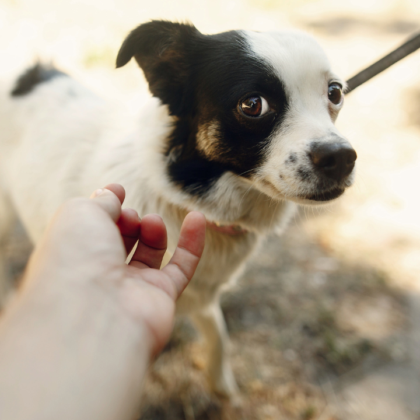
People who are new to working with fearful dogs often want to know: how long will this take? It’s a reasonable question. It’s also, in a certain sense, the wrong one.
The timeline for a frightened dog’s progress belongs to the dog. Not to the handler’s schedule, not to the training plan, not to the well-intentioned hope that if we just keep doing this, the dog will come around by Tuesday. The dog is the clock. And once you genuinely accept that, not as a consolation but as an actual working principle, things often move faster than you’d expect.
What ‘Dog-Driven’ Actually Means
A dog-driven timeline isn’t passive. It doesn’t mean sitting back and waiting for the dog to decide they feel like participating. It means constructing every session so that the dog’s own responses tell you what to do next.
In Treat/Retreat, the dog’s position and movement are the data. How close did they come? Did they come easily, with good balance and fluid movement, or were they stretching and reaching, putting as much distance between their back end and the person as they could while still getting the treat? Did they return on their own, or did they need more time? Could they take the food at all?
Every one of those observations is information about where the dog is today. Not where they were yesterday, not where you’d like them to be. Today. Now. In this session. And today’s information determines what today’s session offers.
Why Pressure Defeats the Purpose
There’s a version of working with fearful dogs that looks like patience but isn’t, where the handler waits for the dog to comply rather than waiting for the dog to genuinely feel ready. The difference is subtle but consequential.
When we push the pace, when we read hesitation as something to push through rather than something to listen to, we are, however gently, asking the dog to override what they know about their own safety. We’re asking them to suppress information rather than act on it. That can produce results that look like progress: the dog who now approaches, who takes the treat, who stays in proximity. But the learning underneath is fragile, because it was built on the dog learning to ignore their own signals rather than learning that the signals themselves had changed.
A dog-driven timeline means trusting that what looks like slow progress is often the most direct route. Because each step the dog takes is a step they chose, which means each step is solid.
What Progress Actually Looks Like
Progress in a dog-driven approach isn’t always measured in feet. Sometimes it’s the quality of movement at the same distance, the dog who comes back for a second pass where last week they only came once. Sometimes it’s the dog taking the food more easily, with less of that grabbing, stretched-out urgency that signals they’re still operating from anxiety rather than curiosity. Sometimes it’s simply that the dog finished the session still willing to engage, still able to eat, still showing interest in what happens next.
These aren’t small things. They’re evidence that the dog’s internal experience is shifting. And because that shift is happening from the inside, because the dog is moving toward something they’re genuinely finding less alarming rather than simply enduring something they’ve learned to tolerate, it tends to hold.
The Paradox of Letting Go of the Timeline
Here’s what experienced practitioners of Treat/Retreat discover over time: when you genuinely stop trying to manage the timeline, the dog often moves faster. Not always. Some dogs carry histories that require more time, more patience, more careful construction of safety before they can begin to trust. But the handler who is no longer mentally urging the dog forward, who is genuinely comfortable with wherever the dog is today, creates a different quality of session. The pressure lifts. The dog feels it. And sometimes that’s the exact thing that allows the next step to happen.
The dog-driven timeline is not a concession to slowness. It’s a recognition that the dog’s pace is the most efficient one available, because it’s the only one that produces learning that lasts.
Our Treat/Retreat Certification Course is always open – and in the month of May you can take advantage of our annual sale. Normally $1499 you can get it for just $999 – that is just a few days away!
